
Gypsum board — also called drywall or plasterboard, and known in Arabic as جبس بورد — is the backbone of modern interior fit-out. Yet choosing the wrong board for a room is one of the most common and most avoidable mistakes on a finishing project. This guide explains the main board types, where each one belongs, and what to ask your contractor before work starts.
Standard gypsum board
Standard (regular) board is the default choice for dry interior areas: living rooms, bedrooms, offices, corridors and most ceilings. It is economical, easy to cut and finish, and takes paint well. It should not be used where it will meet regular moisture or splashing, because the paper facing and gypsum core absorb water and lose strength.
Moisture-resistant gypsum board
Kitchens, bathrooms, laundry rooms and other humid areas call for moisture-resistant board, which uses a treated core and facing to cope better with water vapour. It is designed for humid environments — not for permanent immersion or continuous direct contact with water. In wet zones such as shower enclosures, the board must be combined with a proper waterproofing system and a tiled finish. In coastal cities such as Jeddah, Dammam and Al-Khobar, high humidity makes this choice worth considering even for rooms that look dry.
Fire-rated gypsum board
Fire-rated (fire-resistant) board has a core reinforced with glass fibre and other additives so it holds together longer in a fire. It is used for walls and ceilings that must provide fire separation — around stairwells, service shafts, plant rooms and between tenancies.
One point is often missed: a fire rating belongs to the complete tested system — framing, number of board layers, fixings, insulation and joint treatment — not to the board alone. Always ask for the manufacturer's tested system data and confirm it against the Saudi Building Code and civil defense requirements that apply to your building.
Acoustic gypsum systems
Sound control comes from the whole assembly rather than one special board: double layers of board, insulation inside the cavity, resilient fixing and sealed edges all improve performance. Meeting rooms, offices, clinics, hotels and home cinemas benefit most. Sealing matters as much as board choice — a small gap around a pipe, socket or ceiling junction can undo an otherwise good partition.
Impact-resistant and specialty boards
Busy corridors, schools and industrial offices may need tougher boards with denser cores that resist knocks. Curved bulkheads and coves use flexible or thinner boards laid in several layers to follow the shape.
Quick guide: which board where
- Bedrooms, living areas, offices and most ceilings: standard board
- Kitchens, bathrooms, laundry rooms and humid areas: moisture-resistant board, with waterproofing in wet zones
- Fire separation walls and ceilings: fire-rated board inside a tested system
- Meeting rooms, hotels and clinics: acoustic system with double layers, insulation and sealed edges
- High-traffic corridors: impact-resistant board
Mistakes to avoid
- Using standard board in wet areas to save money — swelling, mould and repainting follow.
- Assuming a fire-rated board on its own gives a fire-rated wall.
- Leaving gaps at board edges, around pipes and at ceiling junctions in acoustic partitions.
- Closing up before inspection — framing, insulation and MEP first-fix must be checked before boards go on.
- Rushing joint finishing — poorly taped joints show as cracks under paint.
What to ask your contractor
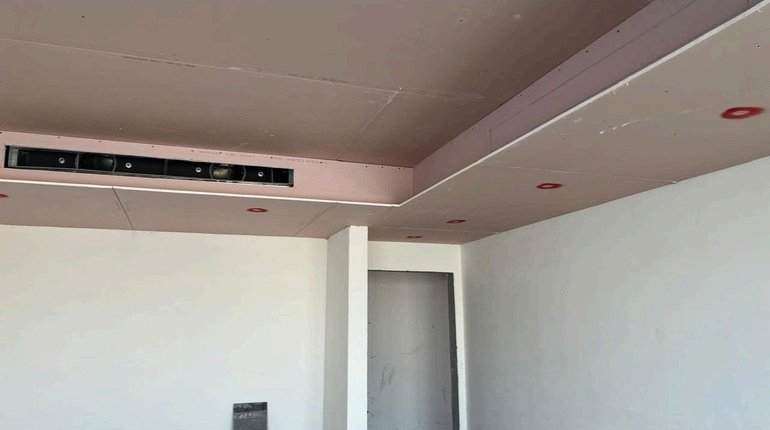
Before you approve a quotation, ask which board type is specified for each room, what manufacturer data supports any fire or acoustic claims, who inspects framing and MEP before closing, and what level of finish is delivered before painting. Clear written answers are a good sign of a contractor who controls quality.
Are ceilings different from walls?
Ceilings put the board under constant load, so they need care that walls do not. Boards and framing must be spaced so the ceiling does not sag over time, and this matters more in humid areas where boards can absorb moisture from the air. Ask whether the specified board is suitable for ceilings and how far apart the supports will be. Large ceiling spans, recessed lighting and cove details need extra framing to stay flat.
Wet areas: what really goes behind the tiles
Moisture-resistant board is suitable for humid rooms, but the zone inside a shower enclosure is a different story. There, contractors normally use a cement-based tile backer board or an equivalent system together with a waterproofing membrane, and the tiles go on top. Using ordinary gypsum board behind shower tiles, even the moisture-resistant kind, is a frequent cause of failures that show up months later as loose tiles, staining and mould.
How the board is fixed and finished
A gypsum partition is a system, not just a sheet. Metal studs and tracks form the frame, boards are screwed to the frame at regular spacing, joints between boards are taped and filled with jointing compound, and screw heads are covered. The finish is then sanded before primer and paint. Rushed or thin jointing shows up as visible lines and cracks, especially under glossy paint or strong side lighting. If you want a very smooth wall, ask for a full skim coat rather than joint filling alone.
Handling and storage on site
Boards should be stored flat, off the ground, under cover and away from water. Boards that have been left standing in the open, or that sit on a damp floor, can bend, soften and lose their edges before they are even fitted. Good site management protects the quality of the finished wall.
What affects the cost of a gypsum system
Prices depend on the board type, the number of layers, the height of the wall or ceiling, the thickness of the metal framing, whether insulation is included, the level of finish, and how complex the design is. Curved bulkheads and detailed recessed lighting cost more than flat, plain ceilings. When comparing quotations, make sure each one describes the same board, layers and finish, or the totals cannot be compared fairly.
Common questions
Can standard board be used in a bathroom? It is not recommended. Even outside the shower, steam and splashes can damage it. Use moisture-resistant board and proper ventilation.
Is fire-rated board the same as fireproof? No. Fire-rated board resists fire and helps to slow its spread for a stated period as part of a tested system, but it is not fireproof.
Do I need acoustic insulation in every partition? Not always. It is worth adding where privacy or noise control matters, such as bedrooms next to living areas, meeting rooms and clinics.
Does board type affect painting? All types take paint, but moisture-prone areas also need a suitable primer and a paint that copes with humidity.
YYM Prestige installs gypsum partitions, ceilings and bulkheads across Saudi Arabia, from standard systems to acoustic and fire-rated assemblies built to project specifications. Contact us for a free quotation.